Thursday, June 11, 2015

Plant of the day is: Pterostyrax corymbosus or epaulette tree

Plant of the day is: Pterostyrax corymbosus or epaulette tree

It is nice to have a plant I don't have to scrounge around so many different places for information on.  This is a new tree for me but plenty of information out there on it.  I've got a couple little seedlings that I'm holding my breath on whether or not they can make it through the summer.  If not, I'll try again,

Why do we fall?  So we can learn to pick ourselves up.

Not really much in the way of CC images for this either.  Here is site with great info and pictures.

Taxonomy etc.:  A member of the very small Pterostyrax genus.  Just 4 other species in the genus which occur in the Styracaceae family.  The Styracaceae family is also quite small with only 11 genera and around 140 species.  All but the genus Styrax are composed of 5 or fewer species.  The standout genus you might recognize is Halesia (silver bells) of which we have the lovely Halesia carolina that manages to grow in St. Louis when well cared for.  When looking at the flower structure it is easy to see the relationship between Halesia and Pterostyrax.  As an odd detail, the genus is masculine but the species tend to be feminine.  Gender bending plants.  

Description:  A deciduous small tree hardy to about USDA zone 5-6 through 8.  The family is noted for having sprially arranged simple leaves with no stipules.  Flowers are symmetrical with fused petals.  Most species in the family are large shrubs to small trees and this certainly fits that bill, only reaching about 5m in height.  Fruits of the family are usually a dry capsule but this particular genus has fruits that are drupes.  The fruit also has narrow wings that make for the genus name Pterostyrax or "winged styrax".  Flowers are white, occur in early summer, and as you can see above, formed in pendant panicles.  The flowers are small and bell shaped.  Oh, they smell good too.  Supposedly some pretty decent fall color with shades of yellow.

Native Range:  Eastern China and Japan, Thickets around 1300 meters in Kiangs.  Damp shaded areas along streams around 400m to 1600m elevation.  

Culture:  This is where it gets interesting.  I suspect this plant takes a similar environment to our native Hydrangea arborescens.  It occurs in and probably grows very well in dappled or light shade that is moist but well drained.  The downside to this, is that you miss a lot of flowering.  Sunlight is a requirement for good flowering for many a species.  This species can take some full sun, but I should think it would like a little shade in the afternoon/evening.  As with a Hydrangea, the more sun, the more water needed, so plan accordingly.  

Propagation:  I sowed these outside on the 2nd of December (in St. Louis, MO) and by Mid March had germination.  Sown in a poly covered hoop-house so there was no snowfall.  4 out of 8 seeds.  Right on that 50% mark.  Reported as needed a 3 month cold stratification at 5C but definitely good to know that a Missouri winter and spring can provide.  Young seedlings were subjected to some late (but light) frosts with no problems.  

asiaflora.com photo they can come at me if they like.


Tuesday, June 9, 2015

Plant of the day is: Minuartia verna or Irish moss

Plant of the day is: Minuartia verna or Irish moss

Plant of the day WAS going to be Minuartia langii but there is a lot less information out there about it and NO easily found creative common usage images, which is lame.  I'll be taking photos of it and making them available for the masses soon.  Everyone should be able to see/use images of plants by golly.  For me, M. langii is the more attractive/robust of the two, you decide.  Let me Google those images for you. 


Taxonomy, etc.:  Another member of the Caryophyllaceae family.  If I'm being honest, I kind of have a soft spot for the family, some really great looking flowers and plants that grow in some rough soils.  The genus Minuartia is named after J. Minuart, a Spanish botanist and pharmacist.  I love the historical trend of physicians/people in and around medicine also being botanists.  The plants of this genus are typically referred to as the "sandworts".  Several species in Minuartia were formerly in Arenaria and Alsine.  The genus is the second largest in the family in North America, very likely there is one near you.  Minuartia patula or Pitcher's stitchwort.  There you go...sally forth and find it!

Flora of North America has an excellent botanical description of the genus that makes my head spin still.  Must study more.  It's a big genus, 144+ species at least.  A bit of a botanical hotbed for classification.  M. langii wasn't even listed as resolved in theplantlist.org

Description:  A small cushion-forming perennial, likes slag, exposed soils, bare scree, limestone, and basaltic or serpentine soils.  It really rocks.  It of course has the typical 5 petal look of the family but also has 10 very distinctive red/purple anthers that subtly stand out against the white petals.  Leaves are very narrow almost needle like (they remind me a bit of a diet-Phlox) and opposite. (Just found a an error in a published article's abstract in the first sentence...ahhh...a good day).  

Range:  Found throughout northern areas of Britain and in Scotland, it is also in Ireland and found in the Burren and Aran Islands.  Called Spring Sandwort from a decidedly Irish website.  

Propagation/Cultivation:  Germinates VERY well without any pre-treatment of the seed.  Seed is very small and easily sown in large numbers.  Mist bench germination works well but I would think many other standard forms of germination would work as well in temps from 15-20C (yeah, I'm evil, metric system people, it's a thing).  Should be in a VERY well drained mix and allowed to dry out between waterings.  A grit/rock topdress will help keep the algae funk at bay if overwatered a bit.  A fairly forgiving plant though, all things said.

Don't feel obligated to thin the seedlings, they grow quite happily in clumps together and individual plants are rather ...fragile.  If thinning, I'd recommend letting the clump of seedlings grow up quite a bit first.

Great detail.  Love it.

Random fun facts:  A hyper accumulator of copper and zinc in their leaves.  Considerable amounts of Fe, Cu, Zn, and Al have been found on leaf surfaces that were secreted by hydrathodes (a cool thing...look it up).  Possibly a good plant for phytoremediation of certain sites...hmmm.


Monday, June 8, 2015

Plant of the day is: Oreopteris limbosperma or lemon-scented fern

Plant of the day is: Oreopteris limbosperma or lemon-scented fern

It has been quite some time since I've hung out with a fern for a good hour, so here goes.  I ran across this one today and thought of giant flying Oreo pterodactyl hybrid.  Lots of ferns have dinosaur sounding names.  It's a thing.

by James Lindsey at Ecology of Commanster

If you SQUINT you can just make out the hairs on the axis and the yellow glands on the pinnules.


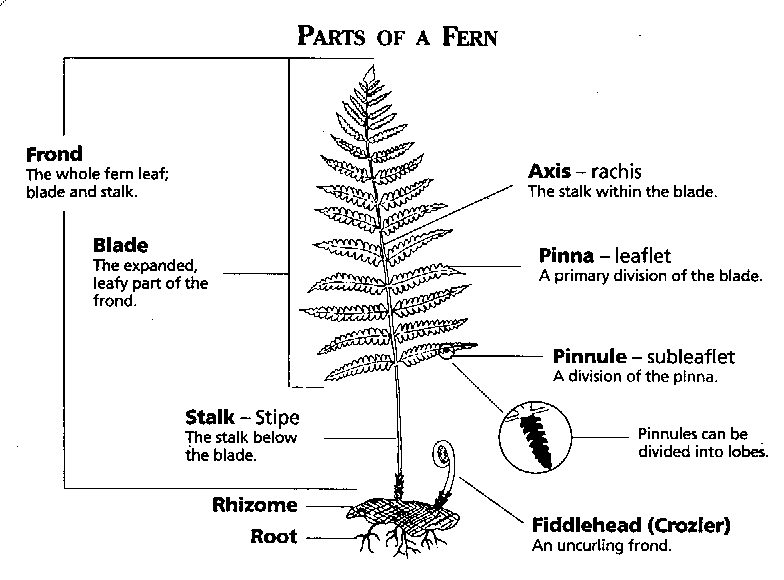
Taxonomy/etc.:  From the Greek oreos:mountain and pteron:wing in reference to the pinnae.  Sometimes called the mountain fern as well.  Quick thing about ferns, they have their own special terminology used to describe their morphology.  Here is a nice diagram so we can all keep it straight together, because I get confused from time to time as well.  

So, the blade is the where the pinnae first start up to the top.  The frond is the entire part from the rhizome, and the stipe is the stem or rachis below the blade.  There we have it.  Ferns don't have leaves, they have pinnae (plural of pinna) that can be subdivided into pinnules.  

You can also find this plant listed as Thelypteris limbosperma because of taxonomists doing taxonomy things.  The genus comes pretty close to being monotypic but there is also one other species O. elwsii that is included in the genus. 

Description:  Probably my favorite group of plants to explore the absurd minutia of differences in classification and ID are the ferns.  Limbo = marginal and spermum = seed.  Marginal seed.  In this case of course it means marginal sori (clusters of spores) BUT back in the day (late 1700s) there wasn't as strong of a distinction between seeds/spores.  The first picture shows the sori (black dots) on the underside of the pinnae.  The individual pinnules aren't quite entirely separate so they can be classified at pinnatifid.  Blade is tapering with shorter pinnae towards the top.  No visible indusia covering the sori.  There are hairs on the axes and VERY small yellow glands.  You'd likely have to have a pretty good loop or magnifier to see the glands. See HERE for a great photo of these characteristics.  It also has a rather distinguishing erect rhizome which can be seen in the illustration below as the brown ...thing...at the bottom of the stipe.

Most commonly confused with a Dryopteris filix-mas which has pinnae that taper lower to the base, even more marginal sori, and is a bit more slender/less scaly.

Range:  Surprisingly tricky on this one.  To fully understand it I'd probably have to spend another hour comparing herbarium specimens.  Apparently there is some debate on whether or not the North American versions should be classified as Oreopteris.  The quick and easy answer is that it is found Europe throughout temperate climates and is certainly a native of the British isles.  Whether or not this species is the same that was recently (1976) found in Newfoundland ...remains to be seen.

Etc.:  Called the lemon-scented fern because there is a faint lemon smell when you brush the fronds (especially young expanding fronds).  


by James Lindsey at Ecology of Commanster

Bonus photo!!  ENJOY!


Thursday, May 28, 2015

Plant of the day is: Swietenia macrophylla or big-leaf mahogany

Plant of the day is: Swietenia macrophylla or big-leaf mahogany

The term mahogany is used to describe several different species of shrubs and trees.  Back in July of last year I wrote about Dalbergia abrahamii or rosewood, an endangered plant from Madagascar that has been over exploited for its absolutely beautiful wood.  It gets me thinking about our use of wood.  I actually am a firm believer of wood being used over plastic/particle board, it just needs to be done responsibly.  Leo Drey just died a couple of days ago, so it is fresh on my mind.  After a recent experience jabbering about how loud a birch snare drum was, it feels right to learn more about the wood used in the much quieter snare to the left.


Taxonomy, etc.:  A member of the Meliaceae family, which I know very little about it would seem.  A look through the included genera leaves me scratching my head and thinking I need to study harder.  It is the Mahogany family which usually have allternate, pinnate leaves without stipules.  Usually evergreen, the family is made of about 550 species.  The Sweietenia genus itself is small with only about 6 accepted species.  The other species used for mahagony wood are S. mahagoni and S. humilis.

Description:  Can reach heights of up to 60 meters that can shoot through the rainforest canopy.  It can live upwards of 350 years.  The bark has a sweet odor.  Small white flowers give way to a truly wonky looking fruit (see below) and some impressive looking seeds as well (I want some.).  Forms up to 71 winged seeds per fruit.  Seeds previously thought to be recalcitrant (don't dry and store long term) are actually orthodox and can be stored cool and fairly dry for extended periods.  I would bet they don't withstand freezing well.  Here is a great .pdf for you nerds.  Swietenia macrophylla King.  The leaves (seen above) can reach a pretty impressive 50 cm (20in).  Macrophylla of course means "big-leaf" in the Latin.

Use:  A highly prized and sought after wood for furniture and musical instruments.  For some nice charts of how wood affects the sound of drums, check out this neat LINK.  I'm all about that bass too, but considering the ecological cost, probably best to use something else.  S. macrophylla is the most important member of the genus following the commercial extinction of the latter two species as a result of over-exploitation.  Sadly, I'm pretty sure this species will one day be mostly eradicated as well, as illegal lumbering in South America is extremely lucrative.  Worth nothing that there is a booming plantation market for this species in India, Fiji, Singapore, etc.  Asian plantation grown S. macrophylla is not subject to CITES restrictions and is your everyday main source of the wood.  It does have CITES protection, but there is a well organized black market.

If you want to get REAL depressed about being a human.  Go to the wiki page and look at the before and after map of it's range.  It's shrinking absurdly rapidly.  Here is the wiki.  I can't help but feel ashamed of my species when I see our will carried out in such a way.  Some estimate that it will also be commercially extinct within five years.  Five.

Range:  The Wiki page has a map, basically the northern/central swatch of South America and smaller every day.

Check the pictures below to cheer up a little :).

Tuesday, May 26, 2015

Plant of the day is: Corynopuntia clavata

Plant of the day is: Corynopuntia clavata

Spent a good part of the day going over the name of the genus in my head trying to memorize it.  I think I've settled on thinking of a child named Cory trying to punt something.

Cory!  No Puntia!

Taxonomy, etc.:  A fairly small genus of about 15 species established by Knuth in 1935.  You can also find synonym references to this as Grusonia clavata.  Corynopuntia are known as the club chollas and are members of the Cactaceae family.  Based on their distribution, they almost half to be (more on that shortly).  It's not difficult to see why they get the name club from, as the pads are more cylindrical than say our native Opuntia humifusa.  Opuntiods are distinguished from cacti by four characteristics.

1.  Stems grow in distinctly jointed segments (hard to see through the spines of these pictures, but they sure do).  The joints form at the onset of the dry season.  Like shutting down shop for the season. Neat eh?
2.  They have glochids on their areoles.  Yeah, think of very tiny barbed spines that come off easily.  These, more than anything are a source of pain and annoyance for the uninitiated into Opuntiods.  The tiny hairs can be VERY painful, the long noticeable spines are easy to avoid but the glochids can really get ya.  Wear gloves and don't touch your face.  I broke this rule, as I used the small spines as a way of not touching the actual stem of the plant.  You can do this with a young segment and a nimble touch but still always wash your hands afterwards.  
3.  Rudimentary leaves are present on new joints.  I did not know this, and will have to keep a close eye.
4.  The seeds have a covering called an aril while other cacti have shiny black seeds.  Think of an aril as a kind of fleshy covering around a seed.  Taxus or yews are an easy seed with a noticeable red aril.  Desertmuseum.org fantastic writeup

ID:  Some ID above for you, but worth knowing that it is clump forming with fairly small stems only 7cm or so with fairly large yellow flowers.  Full description thanks to eol.org here.

Habitat/Range: The genus is present in Southwestern United States and Northern Mexico.  They pretty much have to be in the Americas because of the family.  Euphorbiaceae of similar looks are found in Africa and represent a wonderful the wonder of evolution.  Two families of very different parentage evolving similar form and structure based on environment.  Evolution.  Heck of a thing.

THIS particular Corynopuntia, C. clavata is actually endemic to New Mexico.  I suggest a Spring trip.  It is IUCN listed as 'least concern' because it occurs over a large area and is fairly abundant without any human treats.  The no human threats reason is likely due to the Opuntiods propensity for surviving in very arid climates, they are often found where other cacti cannot subsist.  

Note the Lithurgopsis apicalis bee :).

Culture:  Must be kept quite dry.  IUCN site lists it as being tolerant of temperatures as low as -23C and withstanding snow cover for weeks.  I'm curious if it could be grown here in Missouri.  In the ground might prove tricky, but perhaps in a trough/pot in a location protected from wind.  Should work easily as a houseplant if you've got a lot of light.  South facing windows/supplemental lighting would be a must.

Propagation:  The neat thing about a lot of cacti is that you can just sever a part and let it heal or callus over and it will form roots readily.  With Opuntiods, that segmented growth habit makes things even easier, just snap off a segment.  The VERY IMPORTANT thing to remember is to let the cutting dry and callus before planting.  Don't just stick it right into a moist peaty mix or you'll get rot.  The cutting has plenty of moisture in it to dry out for several weeks.  After waiting a couple of weeks stick the cutting in a well drained, and I mean VERY well drained mix.  Large chunks of perlite, charcoal, and even lava rock with small amounts of soil/compost/peat components.  Water about once a week to establish and that is about it.  I noticed my cutting has begun to swell after a few weeks, which seems a good indicator that it is forming roots and taking up water.  

From seed, make sure the aril is removed, and then treat like any other cactus seed.  A fairly easy method can be found HERE that shares a very similar protocol to fern spore propagation (just with different media).  

Flower is almost as big as plant.  Love that.


Wednesday, May 20, 2015

Plant of the day is: Ancistrocladus robertsoniorum

Plant of the day is: Ancistrocladus robertsoniorum

Full disclosure, all images are actually of Ancistrocladus heyneanus because there aren't any photos with creative commons licensing that exist.  Give it up to Vinayaraj for for noticing this interesting genus and sharing some pictures with the rest of us in the world.

Taxonomy/etc.:  This plant is without a common name as I imagine it might take quite the hunt to find out what it would be and in what language.  I came across this plant today as I had the privilege of helping someone out with some RNA research into the Caryophyllales order.  Plant associates don't stop just at the family level, there are also orders that group together closely related families.  I do always like the representation of evolution as branches on trees.  

This is a very unique plant and is the sole genus of it's family.  A monogeneric family as it is called.  One of it's closest relatives is actually a carnivorous species in another family, which is fairly unusual in the plant world.  Much of the classification of this species and study of it's parentage is thanks to extensive research in molecular phylogenetics which uses DNA to compare similarities/differences.

Description:  All species in the family are large lianas (woody vines) that can reach lengths of over 20 meters (whew!) ...and yes, the fellow I was with today used meters to describe something, I was pleased.  Leaves are alternate.  The vines develop a kind of a hooked thorn that helps them grapple up the sides of other trees/shrubs for support.  On main stems, branching is fairly limited but the lateral (side) stems seem to branch out more and form these hook like structures, which makes sense when you think about it...they're fishing for support.  I'll give you a link for a more in depth description of the flowers because it makes my head spin a little.  Still a long way to go for botanical terminology.  


Range:  Ancistrocladus robertsoniorum can be found in the Buda coastal forest of Kenya.  Next time you're in Kenya, have a look.  If you want to see an Ancistrocladus a little closer to home, you can find a fine specimen of Ancistrocladus robertsoniorum in the Missouri Botanical Garden's Climatron.  Look for it HERE.  The sign is a little tucked away, but it is there, and it is climbing up a nearby tree, you'll see a few of the tendrils sticking out of the tree.  

Why else did it make the plant today?:  Glad you asked.  Turns out, the African species have some really great compounds with medicinal purposes.  Fairly recently A. korupensis has been considered a potential anti-AIDS source by the National Cancer institute and you can be sure pharmaceutical companies all over the world are researching this plants compounds.  West African species are also showing considerable antimalarial activity...which they could certainly use in that part of the world and could benefit many others.

This shows the more dense rosette type growth

And here a bit more sparse

Monday, May 18, 2015

Plant of the day is: Succisa pratensis or devil's bit scabious

Plant of the day is: Succisa pratensis or devil's bit scabious


Plant of the day returns!  The pause was due to teaching my first semester long class.  I really had no idea how much extra work teachers put in outside the class.  I sure do now!  Really excited to get back into this though.  I had some great students, but they can't replace the plants I love.

Taxonomy/etc.:  So if you get in real close, and I mean REAL close you can see that this is an inflorescence with lots of individual flowers.  If you get REALLY close you can see that the individual flowers only have 4 lobes as part of their corolla.  This differs to the otherwise extremely closely related Scabiosa which has 5 lobes.  A member of the Caprifoliaceae family, which still makes me think MADCAP Horse a handy way of remembering several genera of opposite leaved trees and shrubs. M= Maple (Acer) , A= Ash (Fraxinus), D = Dogwood (Cornus), C = Caprifoliaceae (honeysuckle), and Horsechestnut (Aesculus).  This follows the format and has opposite leaves.  The VERY first thing you ever do for plant ID is note the leaf arrangement.  Or maybe if it's got giant spikes or other traps around it...you can do that first.  The Succisa genus is quite small, with only about 4 accepted species.  

ID:  Looks a lot like Centaurea scabiosa but that is in the Aster family..the opposite leaves are the immediate giveaway for ID here.

Range:  Europe, Britain, South and East from Norway to N. Africa, Siberia and the Caucusus

Culture:  Very adaptable really, can handle a wide range of soils and moisture levels but does need a fair bit of sun.  Noted for growing in dry grassland but as long as soil is fairly well drained I don't see why it wouldn't handle some wetter conditions.

Fun Stuff:  O.k. whats with the whole devil's bit thing?  Glad you asked.  This plant has been used in times past for the treatment of scabies, eczema, fever, and notably, the plague.  There are a few variations on the lore, but the one I like involves the devil being displeased at the plants use to cure all of his evil sicknesses.  In his frustration, the devil tried to destroy it by biting the root off.  The root apparently does look kind of devilish.  Finnish and Latin names both come from succidere which means to 'break from the bottom' or 'to reap'


Etc.:  I didn't run across any scientific studies indicating that it IS in fact a remedy for anything.  The young leaves MIGHT be edible (again, don't eat without extensive study) but I'd have to spend a lot more time on it and I have my doubts they'd be tasty.  

Propagation:  Seeds should germinate easily in the Spring.  Currently unsure of their ideal germination temperatures.  Viability testing on this is a work in progress.  


GOOD TO BE BACK!