Monday, November 16, 2015

Plant PERSON of the day is: Thomas Nuttall

An extension of last weeks activities as I just didn't have much time to spend researching throughout the week.  Here is an exceptional botanist and zoologist whose name you can't help but notice around many a taxonomic or horticultural corner.  He was also one heck of an avid birder.

Thomas Nuttal (January 5, 1786 - September 10, 1859)

While he was born in Long Preston England and spent his early years an apprentice printer, around the age of 18 he struck off for America.  He would spend some 33 years of his 73 working in America as a botanist, explorer, and professor.  America at that time was still a vast frontier to the west, and he was a tough and dedicated traveler.  Upon arrival in America, the very next day he came across Benjamin Smith Barton (easily another candidate for a fascinating person) who was in need of a new protege.  Nutall had brought in a cat-brier, or Smilax (which I can tell you...are quite unpleasant to remove from a place you don't want one to be) for identification.  After a quick tutelage in botany, he was doing field botany work for Barton, collecting plants in the salt marshes of Delaware and Chesapeake Bay.

Smilax rotundifolia (those thorns hurt).

Fascinating isn't it?  Those weird moments and plants in life that pull us in a direction?  I was once (jokingly?) threatened that my job depended on being able to ID a plant.  As life would have it I had just researched it a few days before.  Mine was Ipomea hederacea.  Whew.  Close call.

After a successful trip in the summer of 1810 to the Great Lakes region Nuttall ignored Barton's instructions to return to Philadelphia and instead took a trip down the Missouri river to ...St. Louis!  After another brief stint at a local newspaper, he met fellow botanist John Bradbury (Liverpool botanical gardens) and the two began to collect specimens and catalog many plants.  The area had been visited by Lewis and Clark in 1804 but their entire 1805 spring collection was destroyed by floodwater.  Meaning that Nuttall's documentation and samples are some of the first introductions of many North American species.  Cool.  

Later he would travel further up the Missouri River where he would discover the Calochortus nuttallii or sego-lily.  Unfortunately the threat of war between England and America loomed and he had to return to London with his vast collections.  If I'm Barton, I'm definitely wondering if I'm ever going to see all these specimens.  


Back in London, he publishes a small pamphlet with Fraser's Nursery and validly publishes new species like Eriogonum flavum, Oenothera cespitosa, Penstemon grandifloram, Yucca glauca, and one of my favorites, Oenothera macrocarpa.  If you ever see a 'Nutt.' at the end of any of these species, now you know why.  Basically because a guy ignored his boss and struck off on his own.

He did come back after the conclusion of the War of 1812 and headed to the Southeast, later writing about the Eriogonum genus (Greek - erios and gonos meaning wooly knees).  He surmised it would be a large genus when the west was fully explored, despite only knowing 4 species.  It's around 245 now (good guess!).  He also proposed the genus Collinsia.  You might know Collinsia verna, the Spring blue eyed Mary.  

Photo Credit: zen Sutherland (CC BY-NC-SA 2.0)

After that round of trips he shortly published, in 1818, his Genera of North American Plants in Philadelphia.  Back out on the Mississippi and then the Red River, he made it down to Fort Smith and spent time in Arkansaw and Oklahoma before turning south to New Orleans and sailing back to Philadelphia.  He then wrote Journal of Travels into the Arkansas Territory during the year 1819.  If you ever want to see what feuding botanists do, check out the interaction between Pursh and Nuttall.  I side with Nuttall.  

In 1825 he became the curator of the botanical gardens at Harvard University during which he published his Manual of the Ornithology of the United States and of Canada.  In 1834 he resigned his post and again went out west through Kansas, Wyoming, and Utah and eventually sailing across the Pacific Ocean to the Hawaiian Islands.  All of this he did in a year and then came back and botanized in the Pacific Northwest in 1835.  He did a stint at the Academy of Natural Sciences in Philadelphia, contributed to the Flora of North America and North American Sylva which was the first book to include all the trees of North America before moving back to England to inherit property from his uncle.  He lived in St. Helens, Lancashire until 1859 and is buried at Christ Church in the nearby village of Eccleston.

What a life and a legacy.  This was all before cars and roads and planes people.  He saw a HUGE chunk of North America and has dozens of marine species, plants, and birds named after.  He was truly an amazing and driven human being.  I'll see his name over and over again throughout my life, and every time I do, I'll try to imagine how this country must have looked back then.  I'm sure it was stunning and beautiful and helped make the long treks, hot hikes, and bugs much more bearable. 

Certainly makes me feel like I should be doing more with my life.  Cheers mate.  Life well done.


Tuesday, November 10, 2015

Plant PERSONS of the day are: James Lee and Lewis Kennedy

Plant PERSONS of the day are: James Lee and Lewis Kennedy
   James Lee

Alright, so this is a new task for me, and sadly, I can't find a good image of Lewis Kennedy.  This was the 18th century so times were a little different.  First a little basic information about each and then a bit about how they came together and their influence on horticulture.

James Lee:  Lee was a Scottish gardener who lived from 1715 to 1795.  He actually apprenticed with Philip Miller (story for another time) at the famous Chelsea Physic Garden (which sadly I missed when last I was in London).  He was personal gardener to the Duke of Argyll and imported many exotic species for him.  He was a correspondent of Linnaeus, and was an early adopter and promoter of the binomial system.  In 1760 he published An Introduction to Botany.  Early editions of this book are still available if you go shopping for rare books.  Mighty tempting to pick up a copy.  

    I came across a rather interesting tale about James Lee, a bit of a local legend if you will.  Apparently someone told him of an amazing plant in Wapping that he simply had to see.  Upon seeing the plant, he pleaded for it from a woman who was reluctant to hand it over, as it had been brought from the West Indies by her husband, who had left again on a voyage.  He emptied his pockets of about eight guineas and promised to bring her the first offspring of his propagation efforts.  Long story short, the new plant was a smashing success as he kept a pair of blooming plants in a window and droves of people came to pay a guinea to have it.  Sadly he never made good on his promise to the sailor's wife, but made over 300
guineas that season.  The plant you wonder?  The very beautiful Fuchsia!

One of the most famous introductions made into the horticultural world, still popular.  Thanks to Kennedy and Lewis.

Lewis Kennedy:  Lewis Kennedy was a gardener to Lord Bolton at Chiswick and was the initial proprietor of "The Vineyard" at Hammersmith.  Lived from 1721 to 1782.  About 1745 he entered into partnership with Lee.  Here, since I can't find a picture of him, see him through the work of his grandson  Lewis Kennedy (gets confusing eh?).  Here is a great page about the Kennedys.  Basically it goes Lewis Kennedy, John Kennedy, Lewis Kennedy.  

Listed as "the best example of formal terraced gardens in Scotland"

So now we get into the fascinating tale of Empress Josephine, the first wife of Napoleon.  In the early years of the 19th century, when James Lee Jr. and John Kennedy were in charge of the nursery, Empress Josephine employed them in many capacities at the gardens of Malmaison.  Lewis's son John Kennedy and his son Lewis Kennedy actually had a special permit to travel between England and France at the time (of war) to consult and advise her on her collection.  They reportedly sent her many roses, she was bad at paying her bills, and helped sponsor James Niven at the Cape of Good Hope (another era of continued botanical collections and introductions from the very new and untapped regions of South Africa).  Pelargonias, heaths, ixias, oh my.  The nursery was the first in the world to test hardiness on some of these plants.  

"The Vineyard" at Hammersmith:  Actually did start out as a vineyard.  Around the middle of the 18th century they were producing a good quantity of Burgundy wine.  A thatched house was build with wine cellars beneath it and they turned it into one of the most successful horticultural nurserys ever seen.  "For many years, this nursery was deservedly considered the first in the world" - John Claudius Loudon.  Course he was Scottish too, probably just biased :).  The nursery was also very popular with the Russian Grand Duchess Catherine Pavlovna who made a special visit when Czar Alexander 1 visited England.  Did I mention they introduced the Dahlia in 1818 to the public?  The other hugely significant contribution was the introduction of the China Rose in 1787.  This greatly broadened the scents of roses when they were hybridized with other roses like the damasks.  It was kept in operation until 1885 when the site was developed for Olympia Hall.  Next time you are in Hammersmith, wander into Olympia Hall and imagine the changes these two men brought to the world.  I'm still influenced by them today.


Friday, November 6, 2015

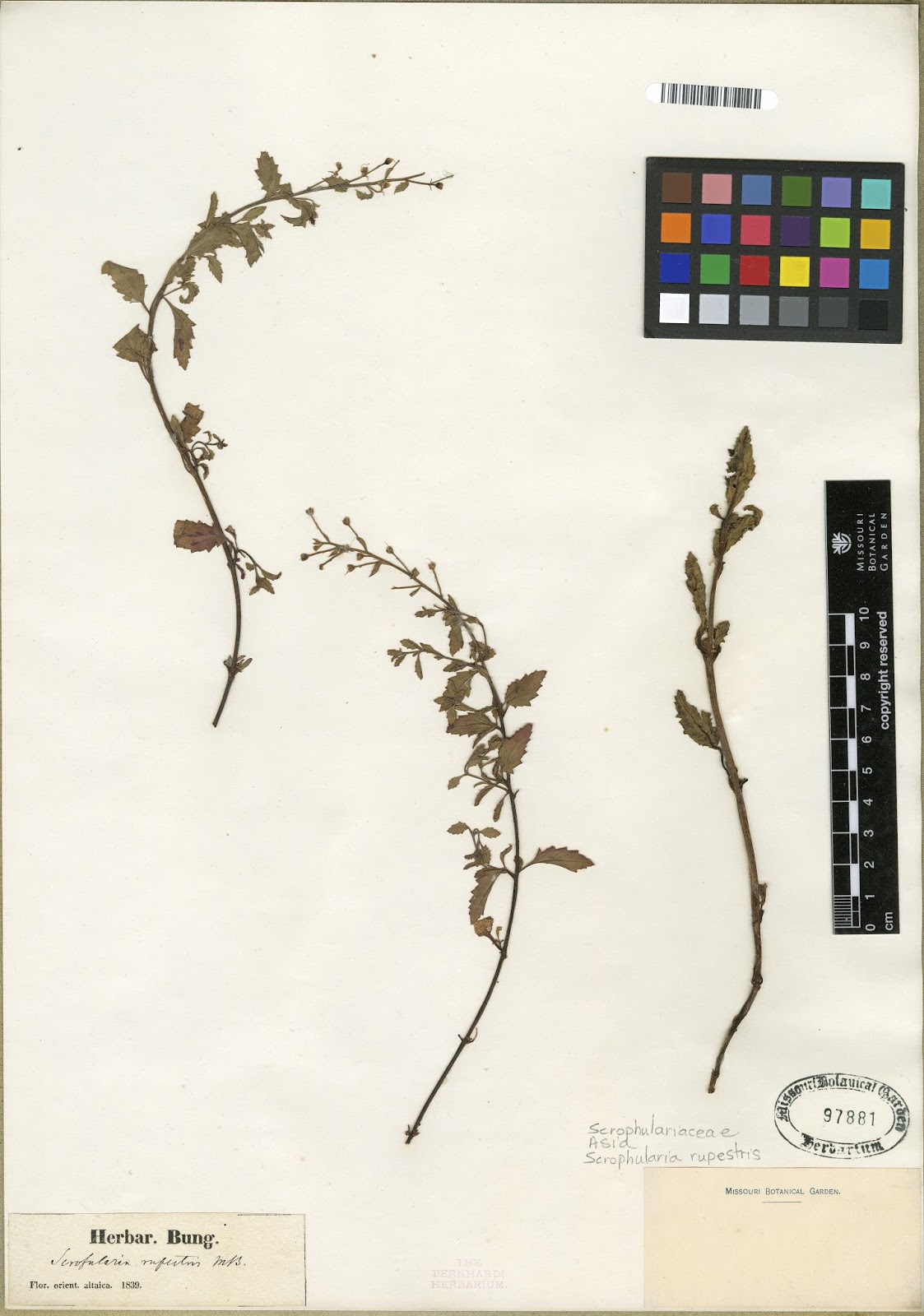
Plant of the day is: Scrophularia rupestris or figwort

Plant of the day is: Scrophularia rupestris or figwort

Tonight's plant got me thinking about the other Scrophularia I grew this year.  Scrophularia nodosa.  I sowed seed from two different sources, one in Berlin, the other in Romania.  The Berlin seed came up marvelously and the Romanian seed did not germinate.  They WERE in slightly different environments, with the Berlin seed in a warmer environment with mist and the Romanian seed in a cooler growth chamber.  Was it the slight differences in moisture or humidity, the temperature, or just seed viability.  These are the questions that make me want more seed.

CC images aren't readily available but there are few excellent ones from Russian sources in their native habitats that are well work checking out.  See links below.

http://www.plantarium.ru/page/image/id/205845.html
http://www.plantarium.ru/page/image/id/135673.html
http://www.plantarium.ru/page/image/id/95838.html

 Missouri Botanical Garden
Herbarium sample collected 1839.  Love this stuff.  Click for far more detail

Foreword.:  Having recently grown a close relative I was happy to see one of our Russian companions, Luba, holding up a lovely bouquet of these.  Apparently she was responsible for some of the wild collected Index Seminum plants offered up to people like me.  Despite the barriers of language, we still spoke the common tongue of the Latin binomial, which conveys more feeling and emotion than you might think.  

Taxonomy, etc.:  A member of the Scrophulariaceae, or figwort, family.  That makes this genus the type genus for the family.  Good stuff.  A goodly sized genus with about 200 species.  The family itself has been changed quite a bit with the onset of phylogenetic evidence, with several genera moved to Lamiacae, Plantaginaceae, and one of my favorites Orobanchaceae (becasue it's fun to say and ...parasitic plants).  Flowers almost always are notably bilaterally zygomorphic, which is an extremely flowery way of saying they only mirror each other when split from the middle on the vertical axis.  Kinda like your face, mostly, cept for the ear thing, and that weird mole.  Anyways, the family is found in the Northern Hemisphere with most species in Asia and a few in Europe and North America.

Description:  Well, I apparently hit the jackpot with this page.  I was having a difficult time tracking down a good botanical description and thought, what the heck, I'll check the full on Russian pages.  Chrome/Google does a pretty decent job with Russian translation, just right click in the page and translate.  Boom.  Good stuff here.  Leaves are opposite, everything but the flowers are covered in profuse glandular white/brown hairs.  Serrate and lanceolate leaves Flowers are a neat read that is difficult for my limited color vocabulary to describe.  They're neat though.  Individual flowers are very small but still manage to be noticeable and beckon you in for a closer look.  

Range:  Steppes, rocky slopes in lower mountainous regions.  The images from the site previously mentioned Russian site are taken mainly in areas near the Black Sea.  Where we collected them, near the Volgograd river, is just north of and smack dab between the Black Sea and the Caspian Sea.  Sometime I hope to go back and explore the areas near the Caspian and Black Seas and I'll certainly make it a point to stop in Volgograd and the area and visit some great friends.  Anyways, it is found throughout a good part of that area.  I'm sure there are some Russian sources more accurate on its exact range.  It seemed a robust plant.  It was in the very dry season so all I have to show is the plant in seed.  Enjoy.

Photo Credit: Derek Lyle

Fun facts:   The Scrophularia genus has SERIOUS medicinal usage.  It is used in Traditional Chinese Medicine for treating arthritis.  It has a powerful painkilling ability equal to that of cortisone and twice as effective as indomethacin, a popular NSAID used to treat arthritis.  Extracts of the plant have been shown to reduce edema and inhibit inflammation.  A lot of plants are used for dubious affect, but THIS plant is the real deal.  Very cool.  It's like the Icy Hot of the plant world, without the Shaq endorsement.  


Wednesday, November 4, 2015

Plant of the day is: Tulipa biebersteiniana

 Today's plant would be a shame for you to not actually see in flower.  No creative commons images available so click here to let me google those images for you.  Worth the click.  Do it!  Do it now!  You'll notice a few great shots just full of fields of it, similar to the environment I encountered it in.  I couldn't see the flower, but it left another of nature's great beauties, a dehisced seed pod.  Here is a nice video showing the process on an Adenium.  The photos you see here were taken at Scherbakovsky Nature Park in Russia.

Photo Credit: Derek Lyle

Taxonomy, etc.:  Tulipa is a member of the Liliaceae family and found throughout Eurasia and North Africa.  75 species are currently accepted with my hybrids and cultivars than you could begin to shake a stick at.  It looks like the most recent classifications of the genus involve for subgenera: Clusianae, Orithyia, Tulipa, and Eriostemones.  Our friend Tulipa biebersteiniana here is a member of the Eriostemones subgenus.  Horticulturists have several other classifications for a total of 15 different groups based on flower morphology.  This is where the true prowess of horticultural selection comes into play.  Tulips cross-pollinate readily, making them a great candidate for what I consider...painting with nature.  I encourage a look at the Wiki page for a great explanation of horticultural divisions and some great examples.  There is a wealth of knowledge about the genus and I can't even really begin to scratch the surface for something like this.

Description/range: Monocot, reaching a height of 20 to 40 centimetres.  Leaves a mid-green, lanceolate with entire margins and alternate.  Produces yellow flowers from April to May and produce loculicidal capsules.  I've mentioned different methods of dehiscence before.  In the photos below you can see an example of loculicidal dehiscense with the pod splitting from the top (rather than the bottom which is septicidal).  Stems are glabrous.  Tepals are yellow with a green blotch near the base (at least for the actual petals, can't the lower sepals).  Found in central regions of Russia, Crimea, western Siberia, Balkan Pininsula and Anatolia.  Thrives in steppes, semideserts and other dry places (but can still handle cold).  For a bit more detail in description/distrubution check the eFloras info.
Photo Credit: Derek Lyle


Cultivation:  I should think this plant would do well here IF given an extremely well drained soil.  They are, of course, geophytes that spend part of their life cycle completely underground protected from the elements.  The drier the summer the better, but any given year, who knows around the Midwest.  Freely produces daughter bulbs so if you get a few happy years you might be able to do some divisions and set up a few climate spots as insurance.  

Propagation:  From seed or bulb divisions.  Unlike lily bulbs, tulips don't have scales so they can't be chipped.  Many growers from seed mention sowing outdoors in the fall in a coldframe.  Seed has a physiological dormancy and I suspect a morphophysiological dormancy (needs a period of warming to fully develop the embryo).  If you want a quick look into the madness of seed dormancy click here.  It's madness.  So if you DO get your seed to germinate, wait till it begins to wither in the later spring/summer heat and then cut off just about all water and let it dry out.  You can keep growing in a pot for a few years like this OR plant out when it is young in the fall.  Either way, be prepared to wait 5 to 10 years for a flower.  Yeah, kinda rough.


Photo Credit: Derek Lyle

Etc.:  Described by Josef and Julius Shultes in 1829.  Appearing in Carl Linnaeus's Systema Vegetabilium.  I was recently reminded of the Biodiversity Heritage Library, an online database of many an old or interesting book that has been scanned.  It is a great resource and a great look back through time.  Some books have absolutely stunning prints worth exploring.

Monday, November 2, 2015

Plant of the day is: Spiraea crenata or scalloped spirea

Plant of the day is: Spiraea crenata or scalloped spirea

You'll notice right off the bat something that vexes me with this genus.  Common name is spirea while the genus is named Spiraea.  You're killin me smalls.  This tough little shrub makes its appearance on account of meeting it in it's native habitat but under cultivation.  You'll see a photo from my recent Russia trip.  It was told to me as Spiraea litwinowii but that is, with a fair degree of confidence it seems, a synonym for Spiraea crenata.


Taxonomy etc.:  I know you can guess the family from the flower right?  If you guessed Rosaceae you were spot on.  If not...you tried and that's the important thing.  It's a pretty good sized one with around 95 genera and a bit shy of 3,000 species.  Spiraea itself is a decent sized family with somewhere between 80 and 100 species, I'll let the taxonomists sort that one out.  Something fun to note is that the genus used to include Filipendula and Aruncus, with Filipendula being very closely related.  There are smatterings of Spiraea across the Northern Hemisphere but the greatest diversity occurs in eastern Asia, where we've obtained many of our horticultural value specimens.  Worth noting that we do have a Missouri endangered Spiraea (its safe in other states).  Spiraea alba is only noted in a handfull of counties in Missouri, mostly north in areas surrounding Sullivan county.  

Description:  Hardy deciduous shrub to 1.5m with slender arching branches.  Inflorescense is umbel-like with many white flowers.  Leaves are lanceolate to obovate, and entire.  They can occasionally have fine toothed or scalloped leaves.  Just to be sure I looked up scalloped in terms of leaf margins.  Crenate.  Just say crenate margin.  Oye!  So many words for things.  Having a hard time with a good botanical description for the species BUT, here is the original published species from Species Plantarum by Carl von Linnaeus himself.  S. crenata is listed as #5 and specifically notes "corymbis" which is in reference to the corymb like structure of the inflorescence which you can see from these photos.  Yes, that IS a scan from the original document.  Very inspiring.  After a bit more of a stint in Russia, the plants are going to start going with some older explorer botanists to tell their stories as well as the plants.  Looking forward to it.


Culture:  Pretty cold hardy, down to zone 4.  Can actually handle quite a bit of drought and full sun.  Naturally found on environments as harsh as some of the steppes of Russia.  Prefers stony, calcareous soils in its native habitat but is adaptable to wide range of soils.  Missouri Botanical Garden website lists as flowering April to May but I certainly saw it flowering in September in Volgograd Russia.  Certainly worth noting that it flowers on old wood so prune immediately after flowering BEFORE new buds have the chance to form.

Taken in Volgograd, Russia
Photo Credit: Justin Lee Creative Commons 3.0 Unported

Thursday, October 29, 2015

Plant of the day is Artemesia solsoloides

Plant of the day is Artemesia solsoloides

Me taking the next picture you see below.  Trippy.
Photo Credit: Derek Lyle

A few firsts for plant of the day today.  Apologies about the hiatus but it's been a busy couple of months.  A return to normalcy is expected imminently.  This is the first plant of the day that I'll be in a photo with the plant.  There are no creative commons images for these plants and there should be.  Please cite https://creativecommons.org/licenses/by/3.0/us/ if using.  

Taxonomy etc.:  This is apparently another playground for taxonomists.  Accepted species range from 200 to 400.  That large of a gap tells me I really don't want to get into things.  Certainly worth noting that it is a member of the Asteraceae family which, as we've recently discussed, is a massive family.  Artemisia is, of course, most recognized for its oils.  Other species, going to use common names, include wormwood, mugwort, tarragon, and sagebush.  Yes, there is a Artemisia absinthium.  Artemisia dracunculus or tarragon is popular in French cuisine.  The tidbit I really like is that some taxonomists have tried to split the genus further but phylogenetic evidence disproves this.  You may have heard me mention phylogentic evidence a time or two before but it is extremely important and valuable in the classification of plants.  It adds a much more discerning layer to classification.  Where traditionally classification was based solely on morphological characteristics, now we have the ability to look at the actual genetic heritage of plants.  It's truly a great time for plant science.  /nerdoff.

                                     
Very calcareous.  


Description:  A perennial that is considered a "basally woody shrublet" with sulcate stems.  Sulcate is a new one for me.  It means "marked with parallel grooves".  Groovy.  Leaves are, for all practical purposes, sessile.  Inner phyllaries have wide scarious-hyaline margins.   Scarious = dry and brownish in color.  Hyaline = almost like glass.  Basically, the involucre bracts are brown and see through.  As the great Donald Rumsfeld put it, "It's a definitional issue".  One of the best players.
If you really want to see the description of the plant enjoy it at the Flora of Pakistan.  Another fine offering from the Missouri Botanical Garden.  They do good things.


A little up close detail
Photo Credit: Derek Lyle

Range/Cultivation:  Found throughout much of Russia, Southern Ukraine, and Caucasus as well as Pakistan and China.  Thrives on very rocky, very well drained calcareous (alkaline) soil.  VERY well adapted to drought as you can see from the images the kind of environment it lives in.  These are images taken from its native habitat just outside Sherbakovsky Nature Park in Russia.  This is on the banks of the Volga River, which you can barely see in the photo above.  Scroll down for a real treat of a shot of the Volga.  Given its latitude it is also very tolerant of low winter temperatures.  I would surmise that it would be hardy in a number of United States climates given appropriate soil considerations.

Great color against the grey white landscape
Photo Credit: Derek Lyle

 Etc.: It was over 90F as we trekked through these areas.  Sadly, I had packed for Russia this time of year and brought all long sleeve shirts and jeans.  It was unseasonably warm unfortunately.  A swim in to Volga was sounding very appealing.

You're going to want to click this for the full affect.
Photo Credit: Derek Lyle


Tuesday, October 6, 2015

Plant of the day is Galatella angustissima or narrow-leaf milk Wan

Plant of the day is Galatella angustissima or narrow-leaf milk Wan

    Shown to me as Galatella angustifolia but I could not find any reference to it as such.  I believe it is likely Galatella angustissima as it is found in dry grassland steppes.  Hunting through all the various asters of the region is quite the task though, so I may be in contact with some very knowledgeable Russians for assistance.  All I was able to see was the remnants of the inflorescence but it was still a beautiful plant to see.  It seems an appropriate plant as I was out today learning the many fall asters of Missouri.  Here is something slightly different from Russia with love.


This photo was taken fairly close to the region we were visiting in Scherbakovsky Nature Park

Taxonomy, etc.:  Galatella is a member of the Asteraceae family.  The Asteraceae family is big, really big.  Something in the neighborhood of 23,600 species and 1,620 genera.  Look out your window, you can probably spot several.  Even those delicious artichokes that we all love, definitely asters.  The problem with a family this large and diverse is that the ID of many species gets VERY involved with the slightest differences in morphology at times.  Galatella was previously included in the Aster genus but was split out with the genus Tripolium.  According to scanning electron microscopy (SEM), the anatomical differences (especially in the epidermis of the leaf blade) warrants the attribution of these genera.  (Article relating to that stuff).  One thing I've already noticed in my brief experience with international botany is the large amount of synonyms used for various species.  Botany truly should be a worldwide collaboration.  

For this particular genera alone there are about 40-50 species found in C and S Europe and NE Asia: 11 species in China.

Description:  Thanks Flora of China (MBG) project for the help on this one.  Not only do they have a great write-up on the species but the genera as well, with a wonderful key.  I'm not going to get into great detail here but here are the highlights.  10-50cm tall with sessile leaves, not gland-dotted.  Lower leaves with 3 veins, upper leaves with 1 vein.  Capitula are numerous.  What are capitula you ask?  Why the plural of capitulum or head.  See below for a friendly and colorful illustration of some of that juicy composite goodness.  I was also looking at differences in the phyllaries of Liatris species today.  Fun stuff.  Achenes (dry fruit covering the seed) are oblong with a yellowish pappus.  What's a pappus?  Who's your pappus?  See below.


Random musings:  I have a picture taken on my phone and labeled at the time of taking as Galatella.  It shows a much different looking plant, mostly because of the yellow flowers.  Seems pretty clear its not G. angustissima.  There may be some yellow Galatella in the area but certainly not the purple one I'm referencing.  I'll have to hunt through photos and hopefully peg these in fall form. 

Anyways, a bit more of a serious post this time to get back into things.  But these next few weeks will feature plants of Russia, specifically areas near and around the Volgograd area.

Enjoy!