Monday, July 15, 2013

Plant of the day is: Clethra alnifolia or sweet pepperbush

Plant of the day is: Clethra alnifolia or sweet pepperbush

So I thought of this plant as I was working up a mental list of plants for my brother's house.  This is a wonderful plant I've spent a lot of time with throughout the seasons and I do enjoy the absolutely bonkers crowds of insects it attracts.

First a picture of the raceme...this one pink, most are white.
Notice that nice little bee.


Why you should look for it and plant it:  It's a great and versatile shrub.  It can be around 2 meters tall and just slightly smaller in spread.  There are some notable cultivars like 'Hummingbird' that are around a meter in height and a little wider more mounded looking.  What makes this such a nice shrub is that it has nice dark green foliage, great looking flowers, a big bee draw, and the ability to handle clay soils.

'Hummingbird' I believe.


Now, the informations on the interwebs will tell you (and yes I did that on purpose) that it prefers wet the moist soils and to avoid placing in dry places.  This is probably a good rule to follow but I have seen these situated on some very dry places but in nice shade and they still seem to do very well.  If you have a particularly low spot, this should be a great and easy plant.  It should handle wet clay well too, which can be a problem soil when looking for an ornamental shrub (Lindera can get a little crazy...).  This shrub is also later in the season to flower, they are just getting into that now in mid July.  A great sequence plant really if you are looking for some white colors well after a lot of your spring flowers have gone.

The one downside I can think of is that it does leaf out fairly late in the season, if you're me, you appreciate having another plant to watch leaf out :).

It is called sweet pepperbush for two reasons.  It has a kind of cloying sweet smell, that I love and am looking forward to smelling VERY soon.  Pepperbush because it has a little bit of winter interest with the seed pods that look a little bit like peppercorns.

So to sum up for the practical application of this plant, it can be planted in pretty shady places, but can also do well with full sun if provided a little moisture.  That being said, planting it on the south or west side of your place is probably silly.

-------------------------------
For the taxonomy/nerdier crowd:

A member of the Clethraceae family, this would then be the ... yes, type genus for the family.  At one point Clethra was considered the only member of the family.  The family now includes the genus Purdiaea, which is found throughout the Caribbean, Central America, and northern South America.

This particular Clethra is native to much of the eastern United States.

There has been a push to reduce the number of species designations (having seen some peoples idea of what qualifies as a unique species I have to agree...) so China has gone from 35 recognized species to 7 for Clethra...crazy right.  According to Wiki the USDA recognizes just 2 here...though I wouldn't trust the USDA in plant ID...just saying.  After looking through Tropicos.org ...well, who knows, maybe we've gone a little slap happy with the different species and varieties here eh?

Well that's all.  If you haven't checked out Tropicos.org I HIGHLY recommend it.  I get lost in there sometimes...an amazing look into botany, taxonomy, and its development.

Tuesday, June 25, 2013

Plant of the day is: Fouquieria splendens or ocotillo

Plant of the day is: Fouquieria splendens or ocotillo

    The absurdity of this name may actually help it stick in my head.  So the two L's in the common name are pronounced as a Y, just so that is on the record.

    So, as a bit of foreshadowing, I was really lucky when in the timing of my trip to Tuscon last spring.  It had rained a little bit right about the time I arrived and things in the desert do go a bit nutty after a good rain.  More on that and this plant soon.

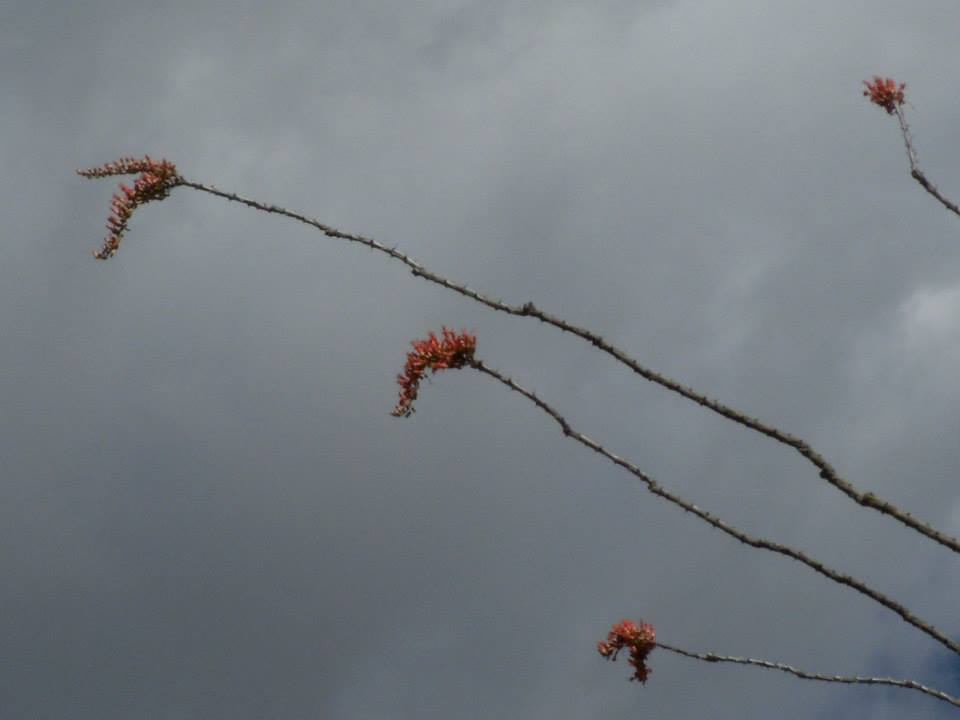
First, how bout a look at one of the reasons this plant is so awesome.

A photo I took - note the lack of leaves on the stem.

    So at first glance, this almost seems like a cactus or maybe a Euphorbiaceae member.  In fact, it is a member of the Fouquieriaceae family, which is remarkably easier to say than it looks after a few tries.  Fouquieria is the type genus for the family, basically what gives the family its ....awesome name.  In fact, it's the only thing that gives it the family name.  Yessir, there is just one lonely genus in the whole family.  You guessed it ...it's Fouquieria.  There are 11 species in this family by the way, all occurring in the southwest/northern Mexico. 

    So yeah, up close it kind of looks like a thin cactus.  On further inspection, it has interesting spikes that form from the underside of the petiole of the leaves and then remain after the leaves disappear.  What leaves you ask?!  These leaves.

Yep, they are greener here right?

    So, being the clever and rather original plant it is (the genus bears little resemblance to any other sort of plant in terms of classification...pretty cool), after a bit of rain it switches into leaf production mode and gets the most out of some growth and photosynthetic energy while the gettin is good.  As the soil dries out, the leaves senesce (mature) and fall off.

   They are indigenous only to the Sonoran desert in the utmost southwest parts of Arizona and California.  I feel pretty lucky that I got to see a lot of them flowering in their native habitat. 

Pollinated by...
And Carpenter bees too

Actually named after french physician Pierre Fouquier.  There is one other particular species in this genera that is also quite fascinating and I'll revisit sometime in the future. 

For now, I hope you've found this information Fouq'ing useful.  

Monday, June 17, 2013

Plant of the day is: Artocarpus altilis or breadfruit tree

Artocarpus altilis or breadfruit tree

    This is another great plant that I got to see a lot of in Jamaica.  They had these planted in opportune spots very near our room so I got to enjoy the crazy ole leaves every day.  I think I commented on more than one occasion that the midribs (and petioles too really) were as thick as pencils.  Check it out.
    It's hard to get a good perspective but I assure you, the leaves are quite large and I've seen some pretty crazy fruit photos...they get big, twice as big as yo head.  

Unfortunately I didn't get a chance to eat the fruit.  Was told that the ripe fruit is baked and according to Wiki and the locals, it tastes a little bit like bread.

Polynesians liked the plant so much they abandoned their endeavors with rice and focused on this instead.  I think they probably made the right call on that one.  Imagine the first people that decided they'd try to eat that...humans are crazy.

So I'm just going to mention really quickly that it is in the Moraceae family or mulberry family.  The fruit gets far too complicated to explain in a sentence or two but if you want a pretty neat fruit structure, feel free to look it up.  It is a monoecious plant and has separate male and female flowers on the same plant.  The males come out first, get the pollen going, and then the females emerge with a LOT of flowers...a lot...I tell you ...its just a lot.

ON TO THE FUN STORY TIME

One of my favorite things about plants is all the crazy stories and histories that surround so many of them.  In this case, during the late 18th century there was a large demand for cheap food to feed slaves on plantations in the Caribbean.  Some lame dude in Captain James Cooks party put up a bounty to anyone that could bring the breadfruit to the area.  Ole William Bligh and his HMS Bounty decided to shore up the task.  They painstakingly got over 1000 pots planted and set sail and ...mutiny.  Somehow the dude made it back from being set out on a long boat.  Well he of course wanted the skrilla so he set out again (with two ships this time) and brought the plants from Tahiti to St. Helena, St. Vincent, and Jamaica. 

Joke was on them, the slaves refused to eat it.  BOOSH!

Moral of that story?  Plants are cool, people are dumb.


Thursday, June 13, 2013

Plant of the day is: Pimenta dioica or allspice/pimento

The transformers nerd in my always thinks about the allspark...

But no, this is the allspice or in Jamaica it was often referred to as the pimento.  The name allspice was actually coined by the English about 1612 who thought it combined the flavor of cinnamon, nutmeg, and cloves.  Indeed when I had some of the sauces that had allspice in it, I thought it had a very complex spicy flavor.  I was a fan, Niki was not so inclined.

The western worlds exposure to the plant came on Columbus's second journey to the Americas.  You know, when he "discovered" them.  His physician Diego Alvarez Chanca actually named the plant and was one of the first Europeans to describe the flora and fauna of the Americas.  European and Mediterranean cuisine adopted the flavor and Jamaica held sway in the exportation of it.

While the leaves of the plant can be used, they do not hold flavor well when dried.  Allspice then, is the dried unripened fruit of the plant.  If Wiki can be believe, it actually stores better whole and un-ground.


Now, for true Jamaican jerk, we were informed by a tour guide that meat must be laid on allspice wood and cooked for uhhh bunch a hours.

SO!

ID:  I have a picture of my own I'll add later when I can dig it up.  It is an evergreen bush/tree growing from 10 to 18m in height.  The bark is kind of light in color and stringy/peeling to look at.  I saw several of them on the drive to the resort and thought the bark looked like the delicious Jabuticaba tree.  For me the bark is a great ID at distance but if there be any question...grab a leaf.  Crush it in your hands and sniff.  It smells awesome, you can imagine my delight sniffing one of these in Jamaica.  Still makes me smile :).


Our guide also correctly informed us that the seeds do not germinate well at all unless they pass through the innards of a bird.  The acidity and/or temperature of the bird guts stratify the seed so that it can germinate.  The eastern red ceder Juniperus virginiana also has berries that benefit from the ole bird belly treatment.

Taxonomy/Morphology:  Also a member of the Myrtle or Myrtaceae family.  The species designation indicates that it is a dioecious plant (damn the spell checkers for making me constantly check ...).  This means that there are separate male and female plants.  The flowers are white but very small and easy to ignore.  

Fun Fact:  The Arawak referred to wooden frames for roasting meat as buccan, so when Europeans showed up and started curing meats this way (often with wood from this plant) they became known as boucaniers ...which later became buccaneers.  Arg matey! A bit of random pirate in this plant there be!


Wednesday, June 12, 2013

Plant of the day is: Syzygium malaccense or _____ apple

I had the pleasure of running into this plant recently in Jamaica.  My sisters wedding doubled as a great opportunity to learn some tropical plants.

Why the ____ you ask?  Well, it turns out that this plant has been flung far and wide throughout the tropical world.  A native of Malaysia, Indonesia, and Vietnam, this plant is edible and I'd say fairly tasty.  In Hawaii it is called the mountain apple and was brought over by Polynesians on canoes.  If I'm packing a canoe for a trip across the pacific, it better be the essentials.

Taxonomy:  According to Wiki, it has one of the prettiest flowers of the Myrtaceae or Myrtle family.  I've got to admit, it IS a very striking flower.  It really reminds me of those ever increasing weedy trees we have here in STL the "Mimosa" tree (more accurately a Persian silk tree) or Albizia julibrissin.  The grouping of these flowers is much denser however.  For any plant nerds out there, the Myrtaceae family is very unique in that the phloem (sugar carrying pipes if ya will) of these plants exist both on the inside and outside of the xylem (water carrying pipes), which is a very nifty thing folks.  The stamens of the family are usually very colorful and showy...see below...all that pink is the male stuff.  See, men can wear pink too...  Another notable plant of this family that is VERY important to Jamaica will be featured soon.


What an amazing carpet right??


Range:  It can't freeze, likes about 60 inches of annual rain and can go from sea level to very high elevations.  It's wide presence throughout the world is proof of its adaptability.

Habit/ID:  Fast growing to 12-18m, pyramidal to cylindrical crown.  Leaves are evergreen and opposite on short petioles.  Leaves a bit leathery, dark green, and glossy on top.

Edible:  Yep, edible, I thought it was quite tasty ...allllmost like an apple but not quite as sweet.  Niki did not care much for them.  My mom was a big fan and destroyed one.  I had the pleasure of getting some right of the tree that weren't quite as ripe and then also eating some at the resort which were much sweeter and just different tasting in general.  A real treat to experience how they ripen up.  There is a large seed in the middle...I did not try to eat that.

Whats the fruit look like?  Here ya go.  The fruit, Niki, and my hand winding up for the kill...


Tuesday, January 22, 2013

Plant of the day is: Alstroemeria spp. or Peruvian lily

Alstroemeria spp. or Peruvian lily

Well I think the picture says it all really why this should warrant a plant of the day spot.  The flower above is most likely a result of interspecific crosses and lots of dedication and hard work.  A shout out to the breeders!  As noted below in Taxonomy I initially was abhorred by the length of the family name and then remembered that I've been seeing Alstroemeria in catalogs for a couple years now and it's not THAT hard to roll off the tongue.  

Taxonomy:  This is the type genus of the family Alstroemeriaceae or the Peruvian lily family.  It is a relatively small family with only 4 genera but those 4 genera do give us about 200 species.  Another really neat genus of this family is Bomarea which is a vine that produces some (often) very pretty showy flowers.  The species Bomarea edulis has been used since pre-Columbian times as a food source (the tubers are edible).

ID:  Well, you should be able to guess right off the bat that this puppy is a monocot, see those flower parts in 3?  Not 6...3 :P.  Well, the "roots" consist of a slender rhizome that forms larger "sausage like" structures that look a bit like thicker tubers.  According to Wiki it looks a bit like a Dahlia.  Comparing the pictures they are a bit different though, the "tuber" like structures on the Alstroemeria are not as tightly grouped as Dahlia.

 Dahlia roots
Alstroemeria roots
                                  
I spoil you guys...  anyways though so the rhizome on Alstroemeria is apparently a little dainty until ya consider its sausages.  Felco shout out!  If you bothered to make it this far this plant, and the family have an awesome and interesting characteristic.  Resupinate leaves!  Thanks to Wiki for have a link to resupinate.  Fancy word for the leaves actually flipping upside down.  Basically they twist at the base of the leaf so that what you see as the upper leaf surface is actually the bottom.  If it weren't so damned late and I had more time I'd like to dig into why oh why it would do this, there is always a reason...

Culture:  Most of the hybrids you'll run into originate from South American species.  The only species note on MoBot's page for Alstroemeria aurea mentions that it is zone 7 hardy.  Last winter, they would have lived in the ground most likely.  They do like medium moisture well drained soils (like everything in the garden seemingly) and in our brutal summers I imagine they would appreciate afternoon shade or a part sun/dappled sunlight spot (this according to MoBot but I should think that sounds spot on...feel free to chime in Jason).  They can be overwintered inside in containers or dug from the soil but again MoBot says the rhizomes are very brittle and hard to dig.  Make sure not to water them.

There is much more I could share abou the ID and the culture and on and on...I recommend any avid gardener give this plant a look for the garden or perhaps to try as an indoor plant.  What a lovely looking flower and there is a lot of information/stories about this plant to be found.  It's a beaut.  Did I mention they are really popular for cut flower arrangements?  See...it never ends....ahhhhh!


Tuesday, January 15, 2013

Plant of the day is: Alseuosmia macrophylla or toropapa

Plant of the day is Alseuosmia macrophylla or toropapa/karapapa 


Well, we'll just see if Jade Lee reads these things.  As she is fan of its habitat range...and maybe she saw some of them?

Range:  This little guy is endemic to the north part of the north island of New Zealand.  It is present throughout the island but on the volcanic plateau it is replaced by another species A. turneri.  It can also be found on the south island but only on the north and west parts of it.  

Taxonomy:  This is the type genus for the small family Alseuosmiaceae ...yet ..NOT one that rolls off the tongue well.  This one is going to be a challange to get to stick I'm afraid.  Depending on where you look there are up to 3 genera included in the family but most often just Alseuosmia and Crispiloba (crispy lobes?? heh).  

ID:  The info on this stuff is pretty limited from what I'm finding just as a warning.  I believe the leaves are alternate but from looking at pictures look like they are almost subopposite sometimes. The flowers are kind of pinkish red.  This is an evergreen and the leaves are serrated/dentate.  Stem also looks very green.  Can grow to about 1.5m high and 1 wide so essentially a shrub.  Apparently semi woody.  The flowers are very fragant and for a mini etymology lesson, Alseuosmia means "fragrant grove."  Macrophylla obviously means "big leaf."

Culture:  Likes moist, shady, well drained spots.  Link refers to loving a rotting log in the woods.

Overall this is a very attractive and nifty plant.  It can be rooted with varying degrees of success from cuttings, layers well, and seed can be hard to germinate.  Possums apparently like it?  

This plant is sold for garden use in NZ, I'm kind of surprised there isn't more readily available info but hey...I don't have that much time tonight to do more of a hunt.

That's it folks, short and sweet.  Alseuosmiaceae ...what a pain.

http://www.vibrantearth.co.nz/catalogue/plantsdetail.php?pid=62&name=Alseuosmia%20macrophylla.

http://nzpcn.org.nz/flora_details.aspx?ID=1488